6 January 2025
Practitioners from across the early years sector have sent strong messages that Birth to 5 Matters (Bto5M) is highly valued and, though more guidance would be useful in some areas, the changes should be kept to a minimum.
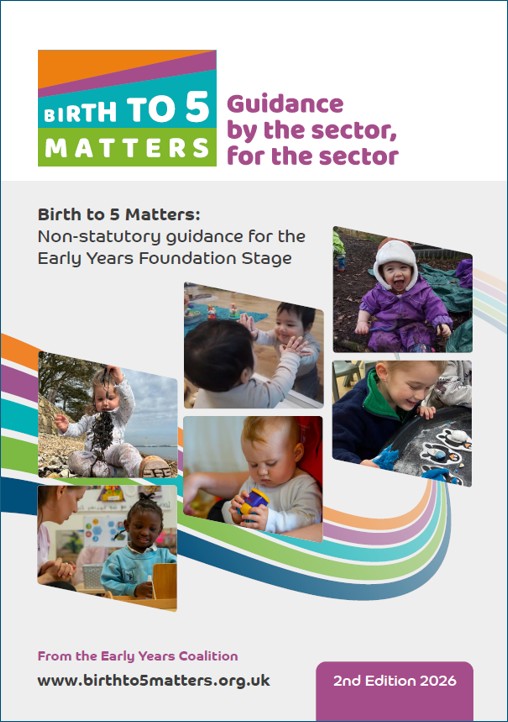
The survey was aimed at informing the current Bto5M Review to update and improve the non-statutory guidance. Responses from over 1300 people showed that Bto5M is valued in initial training and ongoing development of early years professionals, in supporting quality development in settings, and in daily practice to understand children and meet their needs.
Work is now underway in 23 expert Working Groups, who are digesting specific comments from the survey and reviewing new research to produce a draft of a revised Bto5M which will be published for further public comment in the spring.
“In this first stage consultation we are pleased that we heard from people using Bto5M on the ground to support their work with children and families,” said the review project lead Nancy Stewart. “Just over three-quarters of respondents were working directly with children in a mix of childminders, teachers and school leaders, preschool staff and managers. We also heard from lecturers, consultants and students.”
Practitioners reported that Bto5M supports their practice across all areas surveyed (90%+), with highest ratings given to understanding child development, areas of learning and development, and characteristics of effective learning, as well as building confidence to use their professional judgement.
New sections
“Alongside calls not to change the guidance too much and the enthusiasm for the existing material, the survey pointed to some new areas which will be included in the Bto5M revision,” Nancy Stewart said. “We will have new sections on sustainability and digital pedagogy, which reflect priorities that have grown in importance since Bto5M was written.”
The revised guidance will also include a new emphasis on transition in pedagogy, recognising how children are continually changing across the entire period of early childhood from birth. New guidance related to under-2’s will be included, partly in response to new government funding for babies in settings from 9 months.
“At the other end of the spectrum, a section on pedagogy in reception and Key Stage 1 will signal the importance of recognising that early childhood does not end at age 4 or 5,” Nancy Stewart said, pointing out that the survey responses included strong calls for extending the guidance to beyond reception.
Bto5M users reported that they found the guidance well organised with accessible language (95%). The hard copy format is the most popular, though just under half reported using each the downloaded PDF and website versions. Respondents said they chose to use Bto5M for practical support in line with EYFS principles, support for assessment and meeting children’s needs, and understanding child development.
Suggestions for additional materials such as a version for parents and a version for school leaders will be considered by the Early Years Coalition as the review project continues.
Further details of the survey analysis are available in this report.