About Birth to 5 Matters

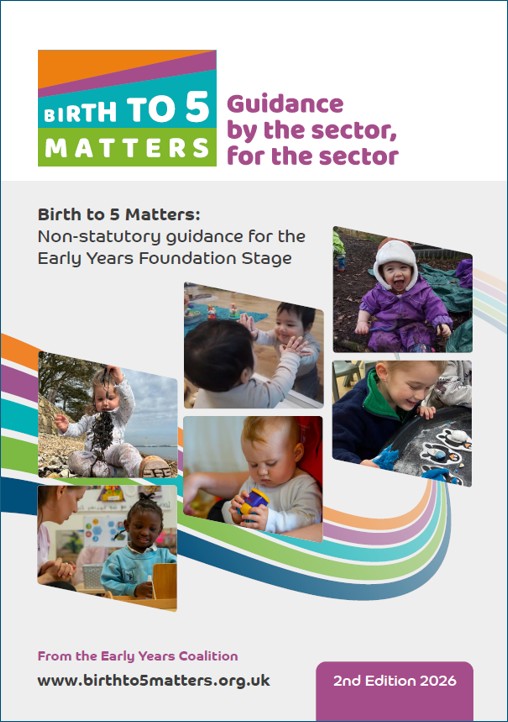
Since its launch in 2021, Birth to 5 Matters has become a go-to resource for much of the early years sector in England. Five years on, this new edition aims to keep everything that is valued about the first edition while expanding and updating it to reflect our constantly changing world, with new sections on digital pedagogy, sustainability, and on adapting pedagogy to children of different ages. We have added a focus on children in Reception and beyond and developed additional guidance for primary school headteachers and leaders.
We have also redesigned the Birth to 5 Matters website to improve clarity and navigation, and provided greater integration with the printed version through the introduction of QR codes, allowing readers to more easily seek out further resources in relation to each topic.
The original guidance was developed by the Early Years Coalition, the members of which came together to create a resource which was rooted in their members’ expertise and experience and embodied their many values, principles and aspirations. The membership of the Coalition has been refreshed, with new partners joining and some of the original organisations having merged. However, the organising principle of the review retained the commitment to the mantra of “by the sector, for the sector”. This guidance remains a reference point for educators developing their practice, not a ‘how to’ manual or a tick-list. Birth to 5 Matters should continue to support educators to implement the Statutory Framework for the Early Years Foundation Stage (EYFS) in a pedagogically sound, principled and evidence-based way. Acknowledging the inseparable aspects of care and education in early years practice, educators can then use their professional judgement based on their knowledge of the children in their setting and their wider context including family, community and the setting itself to construct an appropriate curriculum.
Our aim is, as before, to provide a resource which is accessible across the range of educators to build an understanding of how children typically develop and learn from birth up to the end of the Reception year (aged anywhere up to 71 months), thus ensuring high standards of care and education are achieved. We have added reference to practice continuing into Key Stage 1, acknowledging that early childhood does not end at age 4 or 5. The guidance looks at the unique child in a range of situations and contexts and seeks to provide examples of how the adults and the environment can support and enhance development and learning. These are examples, not a prescriptive list. The trajectories and suggestions for practice may be most useful to trainees and less experienced staff. More experienced colleagues may wish to engage more deeply with the resources and research evidence which underpins the guidance (which can be found on this website or via the QR codes in each section of the PDF and print copies). We hope the mixture of the two provides an accessible starting point as well as opportunities for extending knowledge and understanding for all.
We have once again drawn on a huge volunteer effort from our working groups – including many original members as well as new recruits, and groups newly established for additional content. Those involved included a wide representation of educators, setting types, sector organisations and sources of expertise (see Acknowledgements), and feedback was shared with the sector as we progressed. We have retained the model of publicly sharing our drafts and thinking, inviting any educators who wish to express their views to do so via our consultation surveys. We thank all those who contributed to these processes. We look forward to future dialogues within the sector that build on this guidance as part of continuing professional development and professional reflection, and the continued sharing of professional knowledge and experience.
Early Years Coalition, July 2026