The third year of life is a period of rapid developmental change, so a child who is nearly three is very different from a child just past their second birthday. Each 2-year-old also differs from others in personality, family and cultural experience, and in maturity.


2-year-olds are characteristically enthusiastic about exploring.
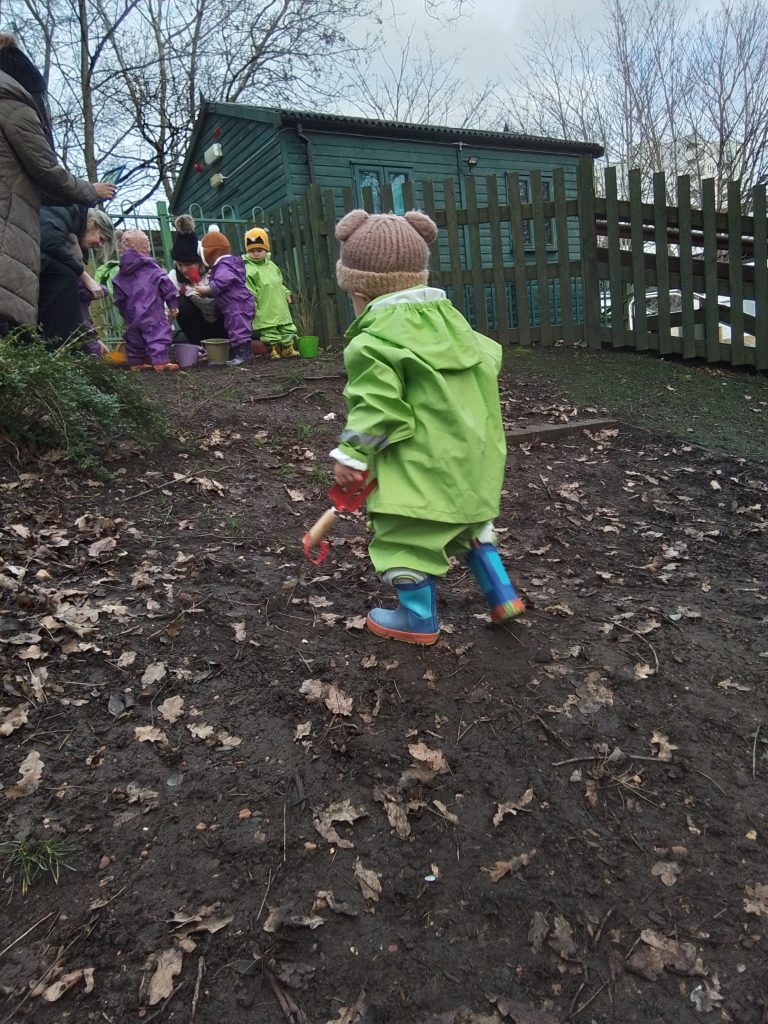
They continually investigate how things work – moving them around, taking them apart, repeating their experiments and observing closely to see the effect of their actions. Understanding how things work leads to using objects and tools imaginatively, making marks and understanding that one thing can stand for another. Their approach is “in the moment” and they focus on the process of their creativity, not a product.
2-year-olds are playing to move and moving to play.
When moving around, 2-year-olds see things from different perspectives, which increases their understanding of spatial concepts. They can become absorbed in their play, particularly when an occupation matches their schematic thinking such as transporting, enveloping, rotation or trajectory. 2-year-olds are supported to learn through their play in generous spaces where educators recognise the importance of children using and moving resources in their own way.
The 2-year-old’s body is at the centre of their experience.
Physical activity refines their growing mobility, agility and dexterity as they become runners, jumpers and climbers. Constantly practising new physical skills can be physically tiring and emotionally wearing for 2-year-olds. Supportive educators encourage free movement in an emotionally safe environment, including finding ways in which children with physical disabilities can be as agile and dextrous as they can. 2-year-olds’ fascination with what their bodies can do is a good starting point for learning about how to look after your body in areas such as using the toilet.
2-year-olds are being and becoming themselves,
experimenting with their own and others’ ideas of who they are. They are exploring being an autonomous person – making decisions, asserting preferences, making choices and experimenting with doing things for themselves. Their persistence and determination are supported by educators who help them to succeed at their task safely but with their sense of competence intact. Adults who support but do not interfere allow 2-year-olds to be confident in their own abilities, while knowing that they can look to others for assistance when necessary.
2-year-olds are characteristically enthusiastic about communicating and being with other people.
They are sensitive to others’ feelings and concerned about relationships. They enjoy the company of other children, observing, imitating, initiating contact and making friends with children with similar interests. Their ability to understand others’ needs fluctuates and is easily overpowered by their own needs, which can make prolonged social engagement challenging so they need spaces to retreat to.
2-year-olds are learning more ways to communicate.
They are already adept at body language, and their spoken language is becoming more sophisticated. They are rapidly adding new words to their vocabulary, and telegraphic speech is turning into sentences which enables them to express themselves more clearly to others. They are still regularly misunderstood by adults and other children, however, which can result in physical expressions of frustration. 2-year-olds are at the very beginning of learning to balance their own needs and desire for autonomy with those of others. Their strong sense of physical self and intense emotions mean that they express themselves through physical behaviours, all of which are communications about their feelings and what they need. Attuned educators support 2-year-olds through building positive relationships and empathising with their challenges.