
The first years of life are a period of rapid development, with each child in a constant state of transition from the awareness and capacities of a newborn to those of a young child a few years later. This changing development across the EYFS requires educators to meet babies and children where they are, adjusting their pedagogy accordingly. Working with babies is quite different to working with 4- or 5-year-olds, and this shift occurs in a gradual progression in pedagogy across the EYFS.
While each child shares overall patterns of development with others, each also follows individual pathways and timing of development. Effective educators observe children’s unique patterns of development and focus on their competencies. This is part of the continuity of pedagogy across the EYFS, rooted firmly in the Foundations of Highest Quality Provision and the principles of Unique Child and Enabling Environments.
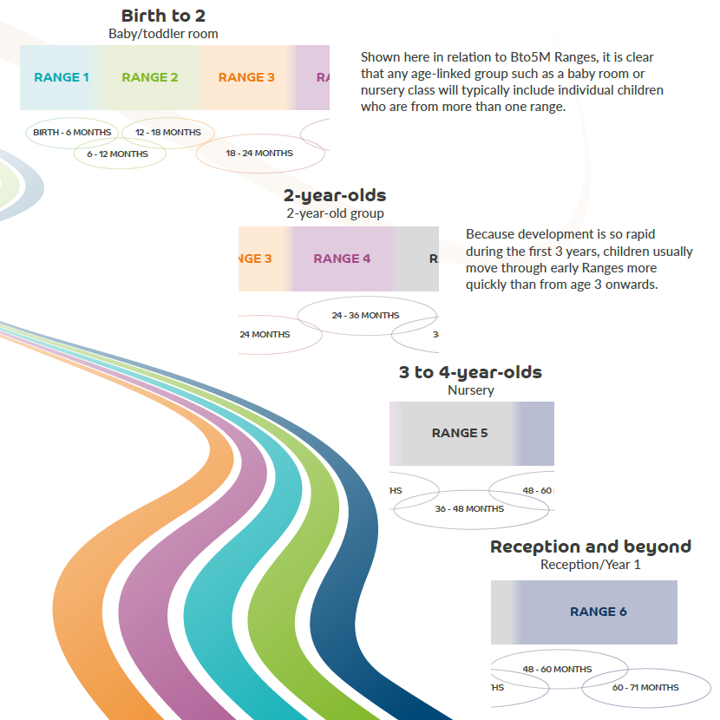
It can be helpful to consider typical aspects of development outlined in the following age/phase discussions, which require appropriate responses from educators. Typical ages are identified as often used in settings’ room or class organisation, but it is important to remember that children may be developmentally at a different stage, including those affected by prematurity, neurodivergence, health issues and so on, and that each child’s needs should be met according to their development and not their age. This is why Birth to 5 Matters prioritises Ranges of development, rather than ages.
Support for every child and family is built on a continuous pedagogy of welcoming and acceptance which is every staff member’s responsibility. As children move through their own pattern of development and into new EYFS contexts, this means:
- accepting that every child is an active agent in their own learning
- ensuring time and space for relationships with adults and peers to develop and grow
- ensuring the ‘voice of the child ‘ is heard by using active listening strategies and observations that enable understanding of the individual child
- prioritising emotional wellbeing through strategies that enable children to be confident, resilient and able to cope with change
- building relationships with parents, family and community with sensitivity and valuing and respecting the richness of cultural differences.
The sections on Birth to 2, 2-year-olds, 3-4-year-olds and Reception and beyond outline typical features of development as children move from birth across early childhood, organised by age ranges as often used for grouping in early years settings.
Understanding typical progression helps educators to respond effectively to children’s needs at different stages of development. It is important to remember, however, that children develop at different rates – there are no precise age cut-offs in development.