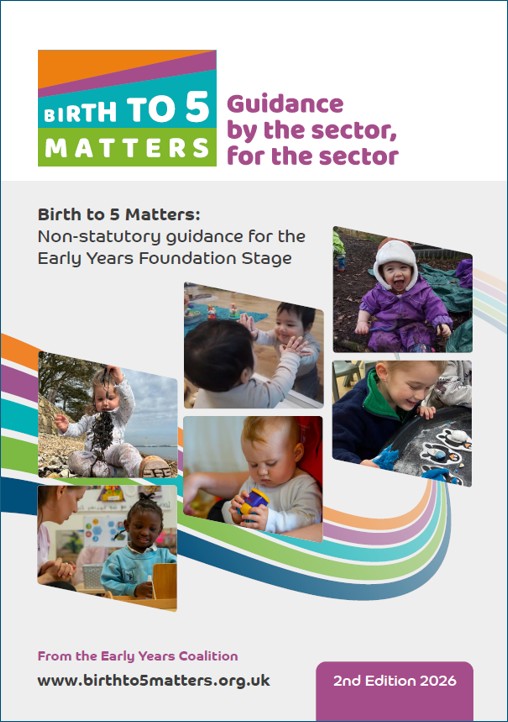
An online survey has been launched to hear views from across the early years sector to guide the review of Birth to 5 Matters (Bto5M). The Early Years Coalition (EYC) is calling for people to get involved to help shape priorities for a new edition of Bto5M.
We’re listening!
Find the survey here.

“As ‘guidance by the sector, for the sector’, Birth to 5 Matters depends on hearing directly from people who implement the Early Years Foundation Stage,” said Nancy Stewart who is leading the Bto5M Review. “We’re looking for a wide response from anyone interested in early years – including practitioners in all kinds of settings, researchers, students and training providers. We want to hear how Birth to 5 Matters is being used in practice, what works well, and what could be improved. We’d like to hear from people who are not using Bto5M too, to understand their views and needs.’
The Coalition is also asking for help to ensure more and varied voices are heard, in a ‘Bring a friend’ campaign. It asks survey respondents, “Could you do one more thing to help? If you can ‘bring a friend’ it will help us to hear the views of people from a wide range of perspectives. Is there someone in your setting whose level of qualification and experience is different from yours? You might encourage them to join in and take part in the survey.”
The survey, which will run until 24 November, asks how well Bto5M provides support across the full range of EYFS practice, as well as for priorities for improvements and whether there are gaps where new guidance sections would be useful.
Possible topics mentioned for extending Bto5M coverage into new areas include understanding and meeting the needs of babies and toddlers, extending principles and practice from early years into Key Stage 1, using digital pedagogies to support young children’s learning and development, citizenship and sustainability.
‘There are straightforward multiple-choice questions, but throughout the survey there are also open questions to capture anything else someone wants to tell us,’ Nancy Stewart said.
In addition to the survey, the initial consultation may include opportunities for people to get involved in a focus group or a setting visit to explain their experiences and views in more detail than a survey allows.
The initial consultation phase will help shape the work of the review. Specialist working groups will then respond to the findings to update the guidance and address any gaps. In the spring there will be another opportunity to be involved, with a survey seeking views on a draft of the revised guidance before the final versions are written.